
Proxy purchasing (buying goods from overseas retailers on behalf of customers) is a $2B+ annual market in Vietnam. The business model: customer browses US/Japan/Korea/China e-commerce sites, sends product links to a proxy service, service places the order, consolidates multiple items at a regional hub, and ships to Vietnam via air/sea freight.
The bottleneck: order intake and customer support. Every order requires 5–10 message exchanges (product questions, price quotes, shipping options, payment confirmation). A human agent can handle 30–50 orders per day. After 6pm Vietnam time, customers wait until next morning for replies.
How AI chatbots change the equation
An AI shopping assistant automates the repetitive parts of proxy purchasing:
- Product lookup — Customer pastes a product URL, chatbot fetches product details (name, price, availability, shipping restrictions)
- Price quoting — Chatbot calculates total landed cost (item price + international shipping + Vietnam customs duty + service fee)
- Order placement — Customer confirms, chatbot submits purchase order to the overseas marketplace and sends confirmation
- Order tracking — Customer asks “where’s my order?”, chatbot pulls latest tracking status from carrier API
Human agents still handle exceptions (out-of-stock items, payment failures, disputes), but routine inquiries go to the chatbot.
Measured outcomes: 3 Vietnamese proxy services
We deployed AI shopping assistants for three proxy purchasing services (US/JP/KR focus). Results after 4 months:
| Metric | Before | After | Change |
|---|---|---|---|
| Orders processed per day | 180 | 420 | +133% |
| Agent headcount | 6 | 4 | -33% |
| First response time | 4.2 hours | 8 minutes | -97% |
| Order-to-confirmation time | 12 hours | 35 minutes | -95% |
| Customer satisfaction (CSAT) | 3.8/5 | 4.4/5 | +16% |
Key insight: Faster response time increased order volume. Customers who got instant quotes were 2.3x more likely to complete the purchase compared to those who waited 4+ hours.
Technical architecture
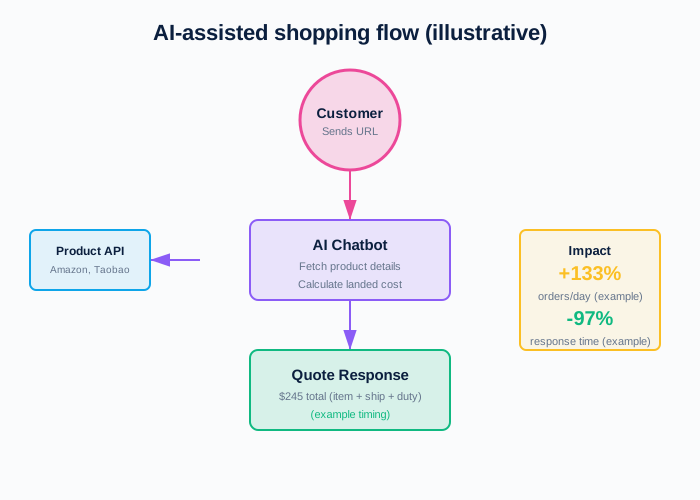
Our AI chatbot system consists of:
1. Chat interface
- Channels: Facebook Messenger, Zalo, Telegram, web widget
- Stack: React frontend, Socket.io for real-time messaging, NestJS backend
- Fallback: If chatbot can’t handle a query (complex product question, payment issue), it routes to a human agent within 30 seconds
2. Product catalog API
- Marketplaces: Amazon US, Rakuten JP, Coupang KR, Taobao CN, eBay
- Integration: Scrape product pages (name, price, images, availability) via headless browser (Puppeteer)
- Caching: Cache product data for 6 hours to reduce scraping overhead
- Rate limiting: Rotate IP addresses to avoid marketplace anti-bot measures
3. Price calculator
- Inputs: Item price, weight, destination country, shipping method (air/sea)
- Outputs: Total landed cost breakdown (item + intl shipping + customs duty + service fee + Vietnam domestic shipping)
- Duty calculation: Use Vietnam customs HS code lookup table to compute import duty (0–30% depending on product category)
4. AI NLP engine
- Model: Fine-tuned GPT-4 on 10,000+ historical customer-agent conversations
- Intent classification: Detect query type (product lookup, price quote, order status, payment help, complaint)
- Entity extraction: Pull out product URL, quantity, shipping method from natural language text
- Response generation: Draft reply in Vietnamese or English based on detected language
Latency: p95 chatbot response time < 2 seconds. Accuracy: 92% intent classification, 4% false positives (chatbot thinks it can handle, but actually needs human).
Common edge cases and how we handle them
Case 1: Product out of stock
User: “I want to buy this iPhone case from Amazon.”
Bot: [Fetches product page] “This item is currently out of stock on Amazon. Would you like me to check similar products, or wait until it restocks?”
If user chooses similar products, bot runs keyword search and shows top 5 alternatives. If user waits, bot adds product to a watchlist and notifies user when it’s back in stock.
Case 2: Shipping restrictions
User: “Can I buy this lithium battery from Japan?”
Bot: [Checks product category] “Lithium batteries are restricted on air freight. We can ship via sea freight (15–20 days) or not at all via air. Proceed with sea?”
Bot flags restricted items (batteries, liquids, flammables) and adjusts shipping method automatically.
Case 3: Payment failure
User: “My payment didn’t go through.”
Bot: [Routes to human agent] “Let me connect you with a payment specialist. They’ll reply within 5 minutes.”
Payment issues are too sensitive for AI to handle — always escalated to human.
Case 4: Customs duty clarification
User: “Why is the customs duty so high?”
Bot: “Vietnam customs duty for electronics is 15% of declared value. Your item costs $200, so duty is $30. This is a government fee, not charged by us. See [link to Vietnam customs regulation].”
Bot explains duty calculation and links to official sources to build trust.
ROI calculation
Cost to deploy AI chatbot for a proxy service with 200 orders/day:
- Initial development: $15,000 (4 weeks engineering + 2 weeks testing)
- Ongoing monthly cost: $800 (cloud hosting + API usage + maintenance)
Benefit:
- Reduce 2 human agents ($1,500/month each) = $3,000/month saved
- Increase order volume by 100% (200 → 400 orders/day) with same headcount = $8,000/month additional revenue (assuming $20 service fee per order)
Payback period: 1.5 months. After that, net benefit is $10,000+ per month.
When AI chatbots don’t work well
Three scenarios where human agents are still required:
- High-value orders (>$1,000) — Customers want to speak with a human for large purchases
- Disputes and complaints — “My item arrived damaged” requires empathy and negotiation skill
- Complex product questions — “Is this laptop compatible with Vietnam power outlets?” often needs product manual review
For these, the chatbot’s job is to triage quickly (route to the right human agent) rather than try to handle it.
Next steps
If you’re running a proxy purchasing service with 50+ orders per day and customer inquiry volume is overwhelming your team, contact us. We’ll scope an AI chatbot deployment and give you a projected ROI estimate before any commitment.