
Most domestic road freight operators in Vietnam still dispatch trucks using Excel. Columns for truck ID, driver name, load assignment, pickup/delivery times. Manual updates via phone calls and WhatsApp messages from drivers.
This works until fleet size crosses 15–20 trucks. Beyond that, dispatch becomes a coordination nightmare: drivers waiting for loads, trucks deadheading back empty, missed delivery windows, and ops staff spending 60% of their day on phone calls instead of planning.
The breaking point
We interviewed 12 Vietnamese 3PL operators running 20–80 truck fleets. Common pain points:
- Load balancing is guesswork — Which truck should take the next load? The one finishing earliest, or the one closest to the pickup? Dispatchers pick based on intuition, not data.
- No real-time visibility — Driver says “I’m 30 minutes away.” Actually 90 minutes away due to traffic. Customer gets angry, dispatcher has no recourse.
- Manual exception handling — Truck breaks down, driver gets sick, customer reschedules pickup. Dispatcher rewrites the day’s plan from scratch.
- No audit trail — When a delivery fails (late, damaged, wrong address), there’s no structured record of who decided what and when.
Result: SLA adherence below 90%, customer complaints, driver overtime costs, and ops staff burnout.
What AI dispatch changes
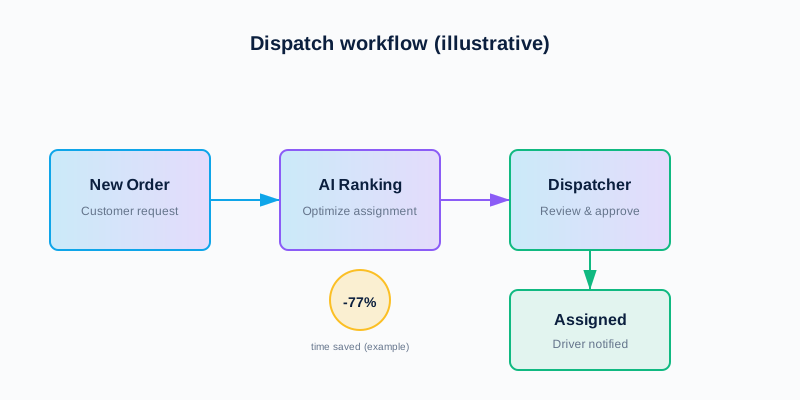
A structured dispatch console replaces Excel with a system that:
- Tracks fleet in real-time — GPS from driver mobile app; updates every 30 seconds
- Suggests optimal assignments — When a new order arrives, the system ranks all available trucks by ETA, capacity, and cost
- Re-routes automatically — If a truck is delayed, the system proposes reassignments to keep other deliveries on schedule
- Logs every decision — Who assigned which load to which driver, at what time, and why
The dispatcher still makes the final call, but now they’re making 10 decisions per hour (approve/reject AI suggestions) instead of 50 coordination phone calls.
Case study: Hanoi-based 3PL with 45 trucks
Before (Excel dispatch):
- 35 loads per day across 45 trucks
- Average truck utilization: 62% (38% deadhead or idle)
- On-time delivery rate: 87%
- Dispatcher worked 11-hour days, 6 days/week
After (Woka Road Logistics System, 6 months in production):
Impact: The dispatcher worked 2 fewer hours per day and took Sundays off, while throughput increased by 20%. AI route optimization was the key enabler.
- 42 loads per day across same 45 trucks (+20% throughput)
- Average truck utilization: 78% (-42% deadhead)
- On-time delivery rate: 96%
- Dispatcher worked 9-hour days, 5 days/week
Key enabler: AI route optimization reduced deadhead by clustering pickups along the same corridor and suggesting backhauls. This freed up truck-hours that could take additional loads.
Technical architecture
Our dispatch system consists of:
- Driver mobile app — React Native, offline-first, GPS tracking, POD photo capture
- Dispatch console — React web app, real-time load board, drag-and-drop assignment, route visualization
- Backend — NestJS + PostgreSQL + Redis, handles GPS ingestion, route calculation, SLA alerts
- AI routing engine — Python microservice, OpenStreetMap routing, traffic API integration, runs optimization every 2 minutes
Latency: p95 dispatch decision latency < 50ms. The system can handle 500 active trucks and 2,000 daily loads on a single cloud region.
What doesn’t change
Even with AI, these still require human judgment:
- Customer negotiations — When a customer asks for a same-day rush delivery, the dispatcher decides whether to accept based on margin and fleet availability
- Driver performance management — AI flags underperforming drivers (high delay rate, low POD compliance), but the ops manager handles coaching
- Exception escalation — When a truck breaks down or a shipment is damaged, the dispatcher coordinates recovery, not the AI
The AI is a decision support tool, not a replacement for logistics expertise.
Deployment timeline
Typical rollout for a 30-truck fleet:
- Week 1-2: Install driver mobile app, train drivers on POD capture
- Week 3-4: Migrate historical load data into the system, configure SLA thresholds
- Week 5-6: Shadow mode — AI makes suggestions, dispatcher uses Excel, we compare decisions
- Week 7+: Live mode — Dispatcher uses AI console, Excel as backup
By week 8, most operators are comfortable enough to retire the Excel sheet.
Next steps
If you’re running 15+ trucks and dispatch is consuming more than 4 hours per day of ops staff time, contact us for a demo. We’ll show you the dispatch console with your fleet data (anonymized) and give you a utilization improvement estimate.