
Rail freight between Vietnam and China has grown 180% since 2020, driven by shorter transit times vs. sea freight and lower costs vs. air freight. In 2026, operators are moving 12,000+ TEU per month across four main border crossings: Lao Cai, Lang Son, Dong Dang, and Mong Cai.
But rail freight is not a drop-in replacement for sea or air. Each mode has distinct economics, transit times, and operational constraints. This post breaks down when rail makes sense and where it still falls short.
The three modes compared
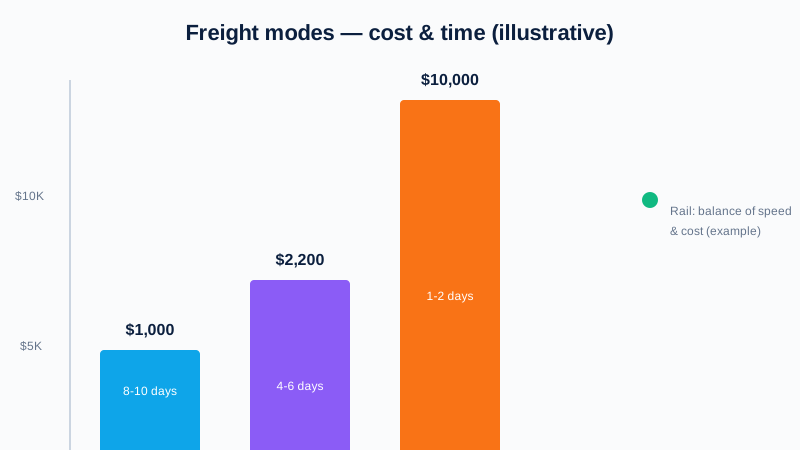
| Metric | Sea freight | Rail freight | Air freight |
|---|---|---|---|
| Transit time (HCMC → Guangzhou) | 7–10 days | 4–6 days | 1–2 days |
| Cost per TEU | $800–1,200 | $1,800–2,400 | $8,000–12,000 (FTL equivalent) |
| Customs clearance | Port, 1–3 days | Border checkpoint, 6–24 hours | Airport, 4–12 hours |
| Load flexibility | FCL or LCL | FCL preferred | Carton-level |
| Best for | High-volume, non-urgent | Medium-volume, time-sensitive | Low-volume, urgent |
Rail’s sweet spot: Shipments that are too urgent for sea (can’t wait 10 days) but too heavy/bulky for air (over 500kg). Common use cases: electronics components, textile raw materials, automotive parts, industrial machinery.
Four operational challenges
1. Border customs bottlenecks
Rail shipments must clear customs at the border crossing (e.g., Lao Cai on Vietnam side, Hekou on China side). This creates a coordination problem:
- Vietnam customs requires pre-declaration 24 hours before train arrival
- China customs requires separate declaration with harmonized HS codes (often different from Vietnam codes)
- If either side flags the shipment for inspection, the entire train is delayed (not just your container)
Impact: Planned 4-day transit becomes 6 days when inspections occur. No visibility into when inspections happen — it’s a black box.
Solution: Pre-clearance programs exist (AEO, trusted trader status) but require 6+ months of compliance history. Smaller operators can’t access these programs.
2. Limited service frequency
Most rail routes run 2–3 times per week, not daily like sea freight or on-demand like air freight. If you miss the departure window, you wait 2–3 days for the next train.
Example: HCMC → Guangzhou rail departs Monday, Wednesday, Friday. If your shipment is ready Tuesday afternoon, it sits in the warehouse until Wednesday. This adds 1–2 days to total lead time.
Workaround: Some operators offer consolidation hubs in Hanoi or HCMC where shipments are staged for the next departure. This works if you have predictable volume, but not for one-off urgent shipments.
3. Infrastructure capacity constraints
The Lao Cai–Hekou crossing handles 60% of Vietnam-China rail volume, but it’s a single-track railway with limited capacity. During peak season (October–January, ahead of Lunar New Year), the line is congested — trains are delayed by 12–24 hours waiting for track allocation.
Alternatives: Lang Son (via Pingxiang, China) and Dong Dang are less congested but have fewer train schedules. Trade-off: more certainty on transit time, but less flexibility on departure dates.
4. Last-mile connection in China
Rail freight delivers to a rail terminal in Guangzhou, Shenzhen, or Kunming — not to your final destination. You still need last-mile trucking to the factory or warehouse. This adds:
- 1–2 days for drayage
- $200–400 per container for local delivery
- Coordination between rail operator and trucking partner (handover can be messy)
Comparison: Sea freight has the same problem (port to door), but sea freight terminals are better integrated with trucking networks. Rail terminals are often industrial zones far from city centers.
Cost-benefit analysis: when does rail pay off?
Let’s compare sea, rail, and air for a 500kg electronics shipment from HCMC to Shenzhen.
Scenario 1: Standard lead time (no rush)
| Mode | Transit time | Cost | Customs risk | Verdict |
|---|---|---|---|---|
| Sea | 8 days | $120 (LCL) | Low | Winner — cheapest, reliable |
| Rail | 5 days | $280 | Medium | Overpay for 3-day time save |
| Air | 2 days | $1,200 | Low | Overpay for 6-day time save |
Recommendation: Use sea freight unless the 3-day time save is worth $160 extra.
Scenario 2: Time-sensitive (customer needs it in 5 days)
| Mode | Transit time | Cost | Customs risk | Verdict |
|---|---|---|---|---|
| Sea | 8 days | $120 | Low | Too slow |
| Rail | 5 days | $280 | Medium | Winner — meets deadline at reasonable cost |
| Air | 2 days | $1,200 | Low | Overpay by $920 for 3-day buffer |
Recommendation: Use rail. Air freight is 4.3x more expensive for a marginal time improvement.
Scenario 3: Ultra-urgent (customer needs it in 2 days)
| Mode | Transit time | Cost | Customs risk | Verdict |
|---|---|---|---|---|
| Sea | 8 days | $120 | Low | Too slow |
| Rail | 5 days | $280 | Medium | Too slow |
| Air | 2 days | $1,200 | Low | Only option |
Recommendation: Use air freight. No alternative.
Woka’s rail logistics system
Our Railway Logistics System addresses the top 2 rail freight pain points:
1. Customs pre-clearance workflow
- Digital declaration — Pre-file Vietnam and China customs forms 48 hours before train departure
- Document automation — Generate waybills, manifests, and packing lists from a single data entry
- Status tracking — Real-time updates when customs flags shipment for inspection; alerts sent to ops team
Outcome: Reduce customs delay from average 18 hours to 8 hours (55% improvement).
2. Multi-modal coordination
- First/last mile planning — Integrate road drayage with rail booking; one shipment object spans HCMC warehouse → Guangzhou rail terminal → Shenzhen factory
- Handover tracking — Capture every mode-switch event (truck to train, train to truck) with timestamp and responsible party
- SLA monitoring — Track end-to-end transit time; flag delays at each leg
Outcome: 95%+ on-time arrival at final destination (vs. 78% with manual coordination).
Market outlook: what’s changing in 2026–2027
Three trends accelerating rail freight adoption:
1. Infrastructure investment
China is upgrading the Kunming–Hekou line to double-track, which will double capacity by Q4 2026. This should reduce congestion and improve schedule reliability.
2. Digital customs pilot
Vietnam and China are piloting a single-window customs declaration system at Lang Son crossing. If successful, this eliminates the double-declaration problem and cuts customs processing time in half.
3. E-commerce volume growth
Cross-border e-commerce from Vietnam to China (and vice versa) is growing 40% YoY. Most of this volume is time-sensitive (fashion, consumer electronics) and weight under 1 ton — perfect fit for rail economics.
Next steps
If you’re shipping 10+ TEU per month between Vietnam and China and struggling with sea freight lead times or air freight costs, contact us. We’ll analyze your shipping lanes and give you a rail feasibility assessment.